Of all the Feng Shui adjustments I have recommended over the years, lucky bamboo is the one people are most likely to already own.
It sits on a desk, in a kitchen window, by a front door — often placed there by instinct, or given as a gift, without any real understanding of what it is supposed to be doing or whether it is placed correctly.
That matters more than most people realise. Lucky bamboo is not merely decorative. In Feng Shui, it is a genuine energetic tool — one that works with specific placements, specific stalk numbers, and specific care requirements.
Placed thoughtfully, it is one of the most accessible and effective Feng Shui adjustments available in any home. Placed carelessly, it does little beyond looking pleasant.
This guide covers everything: why lucky bamboo is considered auspicious in Feng Shui, where to place it, what each stalk number means, how to care for it correctly, and the mistakes that most people make without realising.
If you want to understand how lucky bamboo fits into your home’s broader Feng Shui picture, the complete Feng Shui house guide gives you the full framework.
Why Lucky Bamboo Is Considered so Lucky?
This surprises most people: lucky bamboo is not bamboo at all. It is Dracaena sanderiana — a member of the lily family, native to Cameroon in Central Africa. It has no botanical relationship to true bamboo.
It was given the name because its stems closely resemble bamboo canes, and because in Chinese culture, bamboo has been a symbol of good fortune, resilience, and uprightness for thousands of years.
True bamboo holds deep significance in Chinese tradition. It bends in the wind without breaking — a quality associated in Taoism and Confucian thought with the ability to adapt to adversity while maintaining integrity. Its hollow interior allows Qi to move freely through it rather than being blocked.
These qualities transferred naturally to Dracaena sanderiana when it became popular as an indoor plant, and the name stuck.
The distinction matters practically as well as philosophically.
Dracaena sanderiana thrives in low light and can grow in water — qualities that make it genuinely well-suited to indoor environments where true bamboo would struggle.
It is also extremely hardy, which matters in Feng Shui terms: a dying or deteriorating plant generates stagnant energy rather than positive.
Lucky bamboo’s resilience makes it an energetically safer choice than many more delicate plants.
Why Is the Lucky Bamboo Considered Auspicious in Feng Shui?
The auspicious quality of lucky bamboo in Feng Shui comes from a remarkable characteristic: a single plant embodies all five elements simultaneously. This is unusual.
Most Feng Shui adjustments represent one or two elements. Lucky bamboo, in its traditional presentation, represents all five — which is why it is considered such a complete and powerful symbol of balance and abundance.
Here is how the five elements are expressed in a traditional lucky bamboo arrangement:
Wood — the plant itself. Lucky bamboo’s upright, growing form expresses Wood energy: vitality, upward movement, growth, and renewal.
Water — the medium in which lucky bamboo grows. Most lucky bamboo is kept in water rather than soil, and that water needs to be clean, fresh, and regularly replaced. Water energy governs flow, wisdom, and opportunity. A neglected, stagnant water vessel undermines this element entirely.
Earth — the stones, pebbles, or crystals placed in the base of the vessel. These ground the arrangement, provide stability for the stalks, and bring the stabilising, nourishing quality of Earth energy to the composition. They are not merely decorative — they are an elemental component.
Fire — the red ribbon tied around the stalks or the vessel. Red is the colour of Fire energy in Feng Shui — it activates, energises, and brings warmth to whatever it is associated with. A lucky bamboo arrangement without a red ribbon is missing the Fire element and is considered incomplete in classical Feng Shui terms.
Metal — a metal coin placed in the vessel, or a metal container used instead of glass. Metal energy brings clarity, precision, and refinement. Some traditional arrangements use a metal vessel rather than adding a coin separately.
When all five elements are present, the arrangement represents the complete cycle of elemental energy — which is why a properly assembled lucky bamboo plant is considered one of the most auspicious objects available for a home or office.
Where to Place Lucky Bamboo in Your Home
Placement is where most people get lucky bamboo wrong. The instinct is to put it wherever there is a convenient surface or wherever it looks aesthetically right. Feng Shui placement is more deliberate than that.
Lucky bamboo is a Wood element plant, and Wood element is associated with the East and South-East sectors of the Bagua. These are the zones most naturally supported by the energy lucky bamboo generates.
East — Health and Family
Placing lucky bamboo in the East sector of your home or room activates the Health and Family zone of the Bagua.
Wood energy is the natural element of this zone, which means lucky bamboo placed here is working with the zone’s inherent energy rather than against it.
In my experience, this is the most reliably effective placement for lucky bamboo — particularly for families dealing with persistent health concerns or strained family relationships.
In practical terms, the East sector is the left-hand side of your home when you stand at the front door facing inward (using the BTB Bagua method).
Identify that general area and find a suitable surface within it — a shelf, a side table, a windowsill with indirect light.
South-East — Wealth and Abundance
The South-East sector governs wealth, financial flow, and the accumulation of resources.
Lucky bamboo placed here activates this zone specifically for prosperity.
This is the placement most commonly recommended in Feng Shui writing about lucky bamboo, and it is effective — but I want to be precise about what “effective” means here.
Lucky bamboo in the South-East does not generate money.
What it does is create the energetic conditions that support financial flow — the removal of blockages, the activation of growth energy, the symbolic invitation for abundance to enter and circulate.
Whether that translates into financial improvement depends on many other factors, including what else is happening in the space and in your life.
For a thorough exploration of how to work with the South-East zone specifically, the Feng Shui wealth guide covers it in depth alongside other adjustments that support this zone.
What About Other Rooms?
Lucky bamboo works in any room where it can be placed in the East or South-East sector of that specific room — not just the East or South-East of the whole home. Each room has its own Bagua, and the same directional logic applies.
The living room is an excellent location — it is a Yang space naturally suited to the active, growing energy of Wood.
The living room Feng Shui guide covers how lucky bamboo fits into the broader living room arrangement.
The bedroom, however, is where I consistently advise against lucky bamboo. The bedroom is a Yin space — designed for rest, stillness, and restoration.
Plants in general bring Yang, living energy that works against the bedroom’s purpose. If you currently have lucky bamboo in your bedroom, I would recommend moving it.
The bedroom Feng Shui guide explains this in more detail.
Light Requirements — A Practical Note
Lucky bamboo requires indirect light. Direct sunlight scorches the leaves and turns them yellow — which is both a botanical problem and a Feng Shui one.
A yellowing, deteriorating plant generates stagnant energy.
Always place lucky bamboo where it receives bright but filtered light — near a window with a sheer curtain rather than in direct sun, or in a well-lit interior position away from windows entirely.
Feng Shui Lucky Bamboo Plant — Do’s and Don’ts
Over fifteen years of working with lucky bamboo in real homes, I have distilled the guidance into what genuinely makes a difference and what is simply inherited habit. Here is the complete list.
Do’s
- Place it in the East or South-East sector of your home or room. East activates the Health and Family zone of the Bagua; South-East activates Wealth and Abundance. Lucky bamboo is a Wood element plant and Wood is the natural element of both these zones. Placement here means the plant is working with the zone’s energy, not against it.
- Keep the water clean and change it every two weeks. Stagnant water is stagnant Qi — it defeats the entire purpose of the Water element in the arrangement. Use filtered, distilled, or overnight-rested tap water. Chlorine and fluoride in unfiltered tap water are the most common cause of yellow leaves.
- Tie a red ribbon around the stalks or the vessel. This supplies the Fire element that completes the five-element composition. Without it, the arrangement is energetically incomplete. A simple red ribbon takes thirty seconds to add and makes a genuine difference to the arrangement’s symbolic completeness.
- Place stones or pebbles at the base. These provide the Earth element and practical stability. River stones, polished pebbles, or small crystals all work well. Rinse them when you change the water.
- Keep it in an indirect, bright light. Lucky bamboo comes from the shaded understorey of forests. It tolerates low light well but thrives with bright, filtered light — near a window with a sheer curtain is ideal.
- Ensure the plant has good air circulation. Fresh air supports the Qi that moves through and around the plant. A stuffy, poorly ventilated corner undermines any Feng Shui adjustment placed within it.
- Replace a dying plant promptly. A dead or severely deteriorating plant should be composted and replaced with a healthy one. The symbolic value of the arrangement is only as good as the plant’s actual vitality.
- Keep it away from the bedroom. The bedroom is a Yin space designed for rest and stillness. Plants bring Yang, living energy that works against this purpose. The bedroom Feng Shui guide explains this in detail.
Don’ts
- Don’t place it in direct sunlight. Direct sun scorches the leaves and turns them yellow — both a botanical problem and a Feng Shui one. A deteriorating plant in a key Bagua zone sends exactly the wrong energetic signal.
- Don’t use unfiltered tap water with high chlorine or fluoride. This is the single most common cause of yellow leaves. Switch to filtered or overnight-rested water and the problem typically resolves within a few weeks.
- Don’t let the water stagnate. Change it every two weeks without exception. Stagnant water undermines the Water element and turns the arrangement’s most active ingredient into its weakest one.
- Don’t over-fertilise. Lucky bamboo needs very little feeding — a single drop of diluted liquid fertiliser once a month is sufficient for water-grown plants. Over-fertilising burns the roots and causes the yellowing you are trying to avoid.
- Don’t omit the red ribbon. This is the most commonly skipped element of the arrangement and the one that leaves it energetically incomplete. The Fire element matters.
- Don’t place it in the South sector. South is governed by Fire energy. Wood feeds Fire, which means placing a Wood element plant in the Fire zone tips the elemental balance toward excess. The result can be overstimulation in the Fame and Reputation zone rather than balanced activation.
- Don’t give four stalks as a gift. In Chinese numerology, four is pronounced similarly to the word for death. A four-stalk arrangement is considered deeply inauspicious. You will rarely see it sold, and you should never gift it. Every other number is fortunate to varying degrees.
- Don’t keep a dying plant out of reluctance to let go. This is the Feng Shui equivalent of hoarding — holding onto something past its usefulness and allowing its declining energy to affect the space around it. Let it go and replace it.
Lucky Bamboo Stalks — What Each Number Means
The number of stalks in a lucky bamboo arrangement is one of the most searched topics in Feng Shui, and for good reason.
Each number carries a specific symbolic meaning rooted in Chinese numerology, and choosing the right number for your intention makes the arrangement more purposeful.
One Stalk — Growth and New Beginnings
A single stalk represents simplicity, clarity, and the energy of a fresh start. It is associated with growth from a single point of focus — making it particularly appropriate for someone beginning a new venture, a new chapter, or a period of dedicated personal development. The single stalk, often called a Lucky Log, is popular as a business gift for this reason.
Two Stalks — Love and Partnership
Two stalks represent the energy of partnership — doubled luck, mutual support, and romantic love. It is the most traditional gift between partners and one of the most consistently recommended Feng Shui adjustments for the South-West zone (Love and Relationships) of the Bagua. If your primary intention is to attract or strengthen a romantic relationship, two stalks placed in the South-West sector is a classical and effective placement.
Three Stalks — Happiness, Longevity, and Prosperity
Three is considered one of the most auspicious numbers in Chinese tradition. The three-stalk arrangement combines three of the most sought-after qualities — happiness (Fu), long life (Shou), and prosperity (Lu). This is the configuration I most often recommend as a starting point for people who are unsure which number to choose. It is also the most common configuration for good reason — its intentions are broad, positive, and applicable to almost any home.
Four Stalks — Never Use This Number
As discussed above, four stalks are the single inauspicious configuration in lucky bamboo. The number four in Chinese is pronounced similarly to the word for death. Do not buy it, display it, or gift it. This is one of the most consistent and universally agreed-upon rules across all schools of Feng Shui.
Five Stalks — Balance Across All Life Areas
Five stalks represent balance and enrichment across the five major areas of human experience: emotional, intuitive, mental, physical, and spiritual. For someone seeking overall wellbeing rather than a specific intention, five stalks is a thoughtful choice. It connects naturally to the five elements, reinforcing lucky bamboo’s status as an all-encompassing symbol of balance.
Six Stalks — Luck and Opportunity
Six is associated with luck, particularly the kind that comes in the form of golden opportunities — the right situation appearing at the right moment. For someone at a crossroads or actively seeking new opportunities in career or finance, six stalks carries a focused and relevant intention.
Seven Stalks — Health
Seven stalks is the configuration most specifically associated with health and physical wellbeing. If health is the primary concern — your own or that of a family member — seven stalks placed in the East sector (Health and Family zone) combines directional placement with numerical intention for a reinforced effect.
Eight Stalks — Prosperity and Growth
Eight is considered one of the luckiest numbers in Chinese numerology — its pronunciation resembles the word for prosperity and growth. Eight stalks is associated with financial abundance, expansion, and for those hoping to grow a family, with new life. It is one of the most popular configurations for business settings.
Nine Stalks — Good Fortune
Nine represents completeness and the fullness of good fortune — a wholehearted blessing across all areas of life. It makes an exceptionally thoughtful gift for someone entering a significant new chapter: a marriage, a new home, a major career move.
Ten Stalks — Completeness and Satisfaction
Ten symbolises the wish for complete happiness and fulfilment. It is a deeply generous symbolic gift, expressing a comprehensive wish for wellbeing and satisfaction.
Twenty-One Stalks — The Most Powerful Arrangement
Twenty-one stalks is the most powerful lucky bamboo configuration available. It combines the meanings of all the individual numbers into a comprehensive blessing — tremendous wealth, robust health, abundant prosperity, and deep happiness. It is typically a larger and more significant arrangement, and the most fitting choice for a major occasion: a housewarming, a significant birthday, or an important new beginning.
Caring for Your Lucky Bamboo Plant
Care matters in Feng Shui in a way that goes beyond botany.
A healthy, thriving lucky bamboo plant generates the positive Wood energy it is intended to produce.
A neglected, yellowing, or dying one does the opposite — it signals deterioration and stagnation in the very zone where it is placed.
I have seen this in practice more than once: a lucky bamboo plant that was clearly well-intentioned but poorly maintained, sitting in the wealth corner with yellow leaves and murky water.
The symbolic message of deterioration in the wealth zone is not one you want to be sending, however unintentionally.
Water
Lucky bamboo grown in water — the traditional and most common method — needs its water changed every two weeks at minimum.
Use filtered, distilled, or water that has been left to sit overnight to allow chlorine to dissipate.
Tap water with high fluoride or chloride content is the most common cause of yellowing leaves.
The water level should keep the roots submerged but should not reach the stalks themselves.
Light
Indirect, bright light is ideal. Lucky bamboo tolerates low light well but will grow slowly and lose vibrancy in very dark conditions.
Direct sunlight is the main thing to avoid. A north or east-facing windowsill with a sheer curtain, or a position a few feet from a bright window, is typically perfect.
Temperature
Lucky bamboo prefers temperatures between 65°F and 90°F (18°C and 32°C). It dislikes cold draughts, air conditioning vents, and heating vents. Keep it away from these wherever possible.
Yellow Leaves — What They Mean and What to Do
Yellowing leaves are the most common problem and the most important to address quickly. The causes, in order of likelihood: fluoride or chlorine in tap water, direct sunlight, cold draughts, over-fertilising, or the plant being root-bound in its vessel.
Remove yellow leaves immediately with clean scissors. If the yellowing is widespread, change the water completely, move the plant to a better position away from direct sun, and switch to filtered water.
The Vessel and the Stones
The vessel should be clean and at least two inches wider than the plant. Glass vessels allow you to monitor water clarity and root health easily.
The stones at the base should be rinsed when you change the water. Pebbles, river stones, or polished crystals all work well.
White quartz or clear crystal adds Metal element quality alongside Earth; green jade stones reinforce Wood energy.
Fertilising
Lucky bamboo needs very little feeding. A single drop of diluted liquid fertilizer once a month is sufficient for water-grown plants.
Over-fertilising is a common mistake and produces the opposite of the intended result — it burns the roots and causes exactly the yellowing and deterioration you are trying to avoid.
Where to Buy Lucky Bamboo
Lucky bamboo is widely available — garden centres, florists, home goods stores, and online retailers all carry it. A few things to look for when buying:
- Stalks should be a deep, healthy green — not pale, yellowed, or brown at the tips
- Roots should be healthy — orange or red roots are normal; black or brown roots indicate rot
- The arrangement should already include stones in the base
- Look for arrangements that include a red ribbon, or plan to add one yourself
You can find a good range of lucky bamboo arrangements on Amazon US — including three-stalk arrangements ideal for beginners, seven-stalk arrangements focused on health, and larger twenty-one stalk compositions for significant gifts or home activations.
For UK readers, Amazon UK carries a comparable selection.
Lucky Bamboo and the Broader Feng Shui Picture
Lucky bamboo is one of the most accessible entry points into practical Feng Shui — affordable, widely available, requiring no structural changes, and producing a visible adjustment most people can make within a day. That accessibility is genuinely valuable.
At the same time, it is worth understanding that lucky bamboo is one adjustment among many, not a standalone solution.
It works best as part of a considered approach to the home’s overall energy — alongside thoughtful furniture placement, clutter clearing, good light and ventilation, and awareness of the Bagua zones.
If your primary interest is the wealth and abundance dimension — where most people focus their lucky bamboo placement — the Feng Shui wealth guide covers every relevant adjustment for that zone, of which lucky bamboo is one.
And if you want to approach your whole home with the same intentionality, the complete Feng Shui house guide is the place to start.
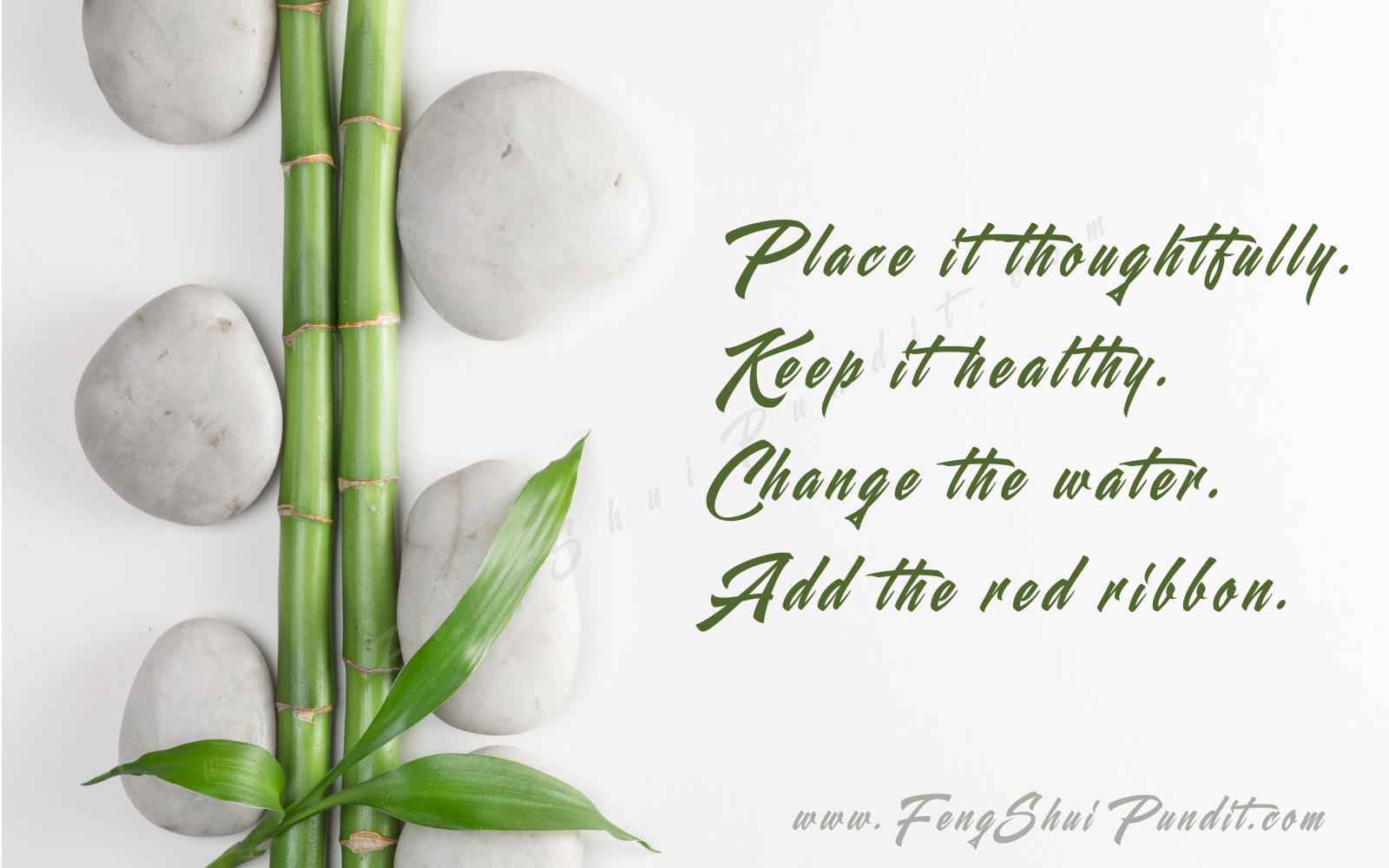
Place it thoughtfully. Keep it healthy. Change the water. Add the red ribbon.
These are small acts — but in Feng Shui, small acts of intention and attention are precisely how the practice works.
Have a question about your specific lucky bamboo situation — the number of stalks, a placement challenge, or a care problem? Leave it in the comments below. I read everything and respond where I can.