
Of all the rooms I have helped people work with over the years, the bedroom produces the most immediate and noticeable results. Not the living room. Not the entrance, though that matters enormously too. The bedroom.
I think the reason is simple: we spend roughly a third of our lives there. Eight hours a night, unconscious and completely open to whatever the environment around us is doing. If that environment is energetically chaotic — cluttered, poorly positioned, filled with the wrong objects — the effect accumulates quietly, night after night, in ways we rarely connect back to the room itself.
This guide covers everything the bedroom needs from a Feng Shui perspective — the layout, the bed position, the colours, what to include and what to remove, and a dedicated section on creating the conditions for romance and intimacy. It is a long read because the bedroom deserves a thorough one. Work through it at your own pace and apply what you can.
If you haven’t already read the whole house Feng Shui guide, I’d suggest starting there first — it gives you the foundational framework that makes everything in this article make more sense.

Why the Bedroom Matters More Than Any Other Room
In classical Feng Shui, the bedroom falls within the domain of rest, restoration, and intimate relationships. These are not peripheral concerns. They are the foundation everything else is built on. A person who sleeps poorly makes worse decisions, manages stress less effectively, and brings less of themselves to their relationships and their work. A couple whose bedroom is energetically discordant — whether they recognize the cause or not — will find that discord showing up in their interactions.
The bedroom is also, critically, a Yin space. In Feng Shui, Yin energy governs rest, quiet, stillness, and receptivity. Yang energy governs activity, stimulation, movement, and output. Most of our waking environments are Yang by nature — offices, kitchens, living rooms where people gather and talk. The bedroom should be the counterbalance: a quiet, calm, Yin sanctuary where the nervous system can genuinely down-regulate.
Most bedrooms I’ve seen are energetically Yang when they should be Yin. Televisions, work desks, exercise equipment, harsh lighting, mirrors that activate rather than calm. The bedroom has become a multi-purpose room, and that multi-purpose quality is exactly what disrupts its function.
The first step in Feng Shui bedroom work is always the same: restore it to its single purpose. Rest and intimacy. Everything else finds another home.
Feng Shui Bedroom Guidelines — For Every Bedroom
Bed Placement: The Most Important Decision in the Room
If there is one thing I would ask you to get right above everything else, it is this: the placement and direction of your bed.
The commanding position — what classical Feng Shui calls the most auspicious location for the bed — has three characteristics. The bed should be positioned so that you can see the bedroom door from where you lie, without being directly in line with it. There should be a solid wall behind the headboard — no windows, no open space. And there should be access on both sides of the bed, not just one.
The reasoning behind each of these is more practical than mystical. Being able to see the door without being directly in its path gives the unconscious mind a sense of security — you are not surprised, not exposed, not vulnerable. Environmental psychologists call this the prospect-refuge dynamic: we sleep better when we can see what is coming while remaining protected. Feng Shui arrived at the same insight several thousand years earlier.
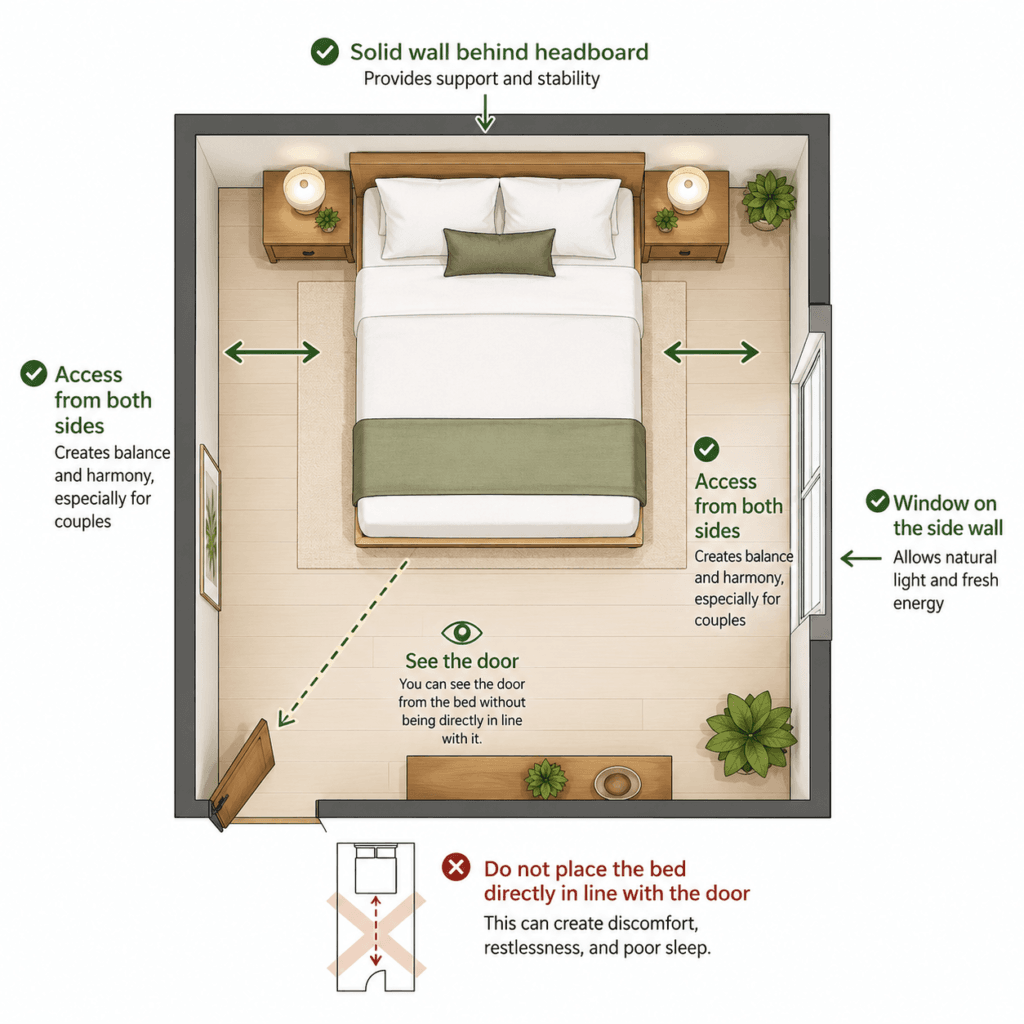
A solid wall behind the headboard provides what Feng Shui calls support — a mountain at your back. Windows behind the head allow Qi to escape and create a subtle sense of instability that disrupts rest. I have seen this recommendation make a meaningful difference in sleep quality more times than I can count, and it is one of the first things I look at when someone tells me their bedroom “just doesn’t feel right.”
Access on both sides of the bed matters especially for couples. A bed pushed against a wall on one side creates an energetic imbalance — one partner is literally boxed in. In my experience, this consistently shows up as an imbalance in the relationship itself. Making room on both sides is a small change with a surprisingly significant effect.
Bed placement: what to do
- Position the bed in the commanding position — diagonal from the door, with a clear sightline to the entrance
- Place the headboard firmly against a solid wall
- Ensure sufficient space on both sides of the bed to enter and exit comfortably
- Choose a bed with a solid wooden headboard — it provides symbolic and energetic support
- Opt for a wooden bed(affiliate link) frame over metal wherever possible. Wood is a grounding, stable material; metal conducts energy and keeps it active when rest requires stillness
Bed placement: what to avoid
- Never place the bed directly in line with the bedroom door — this is the “coffin position” in classical Feng Shui, so named because it echoes how bodies were traditionally carried feet-first through doorways
- Avoid placing the bed under a beam — the downward pressure of a beam above the sleeping body creates subconscious tension and is associated in Feng Shui with headaches, anxiety, and relationship friction
- Avoid a window directly behind the headboard. If your room gives you no choice, use heavy lined curtains or a solid roman blind rather than slatted blinds, which allow Qi to scatter
- Do not align the bed with any corner of the room — the sharp angle points create what Feng Shui calls “poison arrows,” directing cutting energy toward the sleeper
- Avoid beds with built-in storage beneath the mattress where possible. Stagnant energy accumulates in enclosed spaces below where you sleep. If under-bed storage is unavoidable, keep it impeccably organised and use only soft items like spare bedding — never paperwork, old clothes, or broken objects
Mirrors in the Bedroom: Handle With Care
Mirrors are one of the most debated elements in Feng Shui, and the bedroom is where the debate matters most.
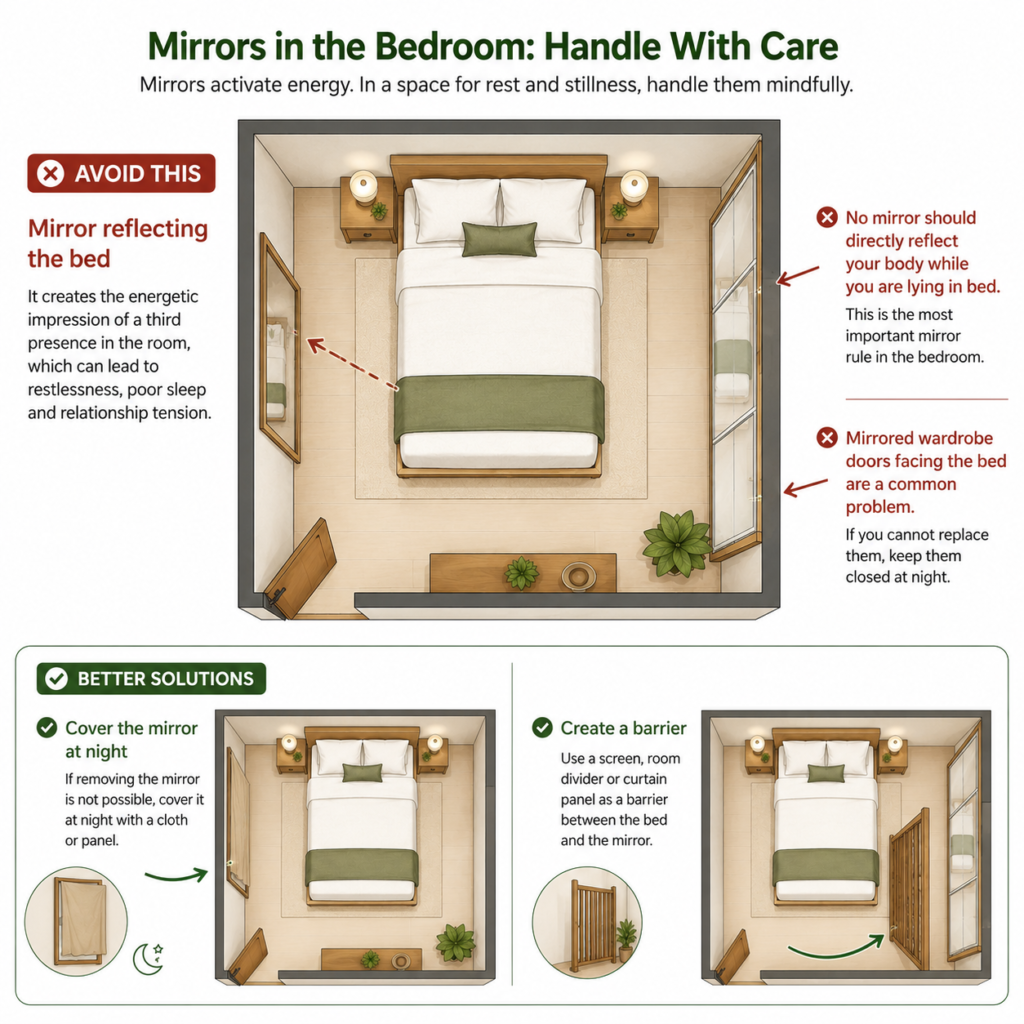
The concern is this: mirrors activate energy. They reflect, amplify, and circulate Qi. In a space designed for stillness and rest, that activation works against the room’s purpose. A mirror that reflects the sleeping body is considered particularly problematic — it creates the energetic impression of a third presence in the room, which classical Feng Shui associates with disrupted sleep, restlessness, and relationship tension.
I want to be honest here: I cannot tell you with certainty that a bedroom mirror will damage your relationship. What I can tell you is that every time I have suggested removing or covering a mirror that directly faced the bed, the person came back to me within a month and said their sleep had improved. Whether that is Feng Shui working or simply the psychological effect of removing a reflective surface that the sleeping brain registers as movement — I genuinely do not know. The result is the same either way.
For a more thorough look at how to work with mirrors throughout your home, the Feng Shui mirror placement guide covers every room in detail.
The mirror rules for the bedroom:
- No mirror should directly reflect your body while you are lying in bed — this is the most important mirror rule in the entire home
- If removing the mirror is not possible, cover it at night with a cloth or panel — this is a completely acceptable remedy and one I have used in my own bedroom
- Mirrored wardrobe doors facing the bed are a common problem in modern bedrooms — if you cannot replace them, keep them closed at night and consider a partial screen or curtain panel as a barrier
Electronics and Technology: The Hardest Change to Make
I know this recommendation is the one most people resist, and I understand why. The television in the bedroom feels like a comfort. The phone on the nightstand feels like a necessity.
From a Feng Shui perspective, electronic devices are Yang in the extreme — they emit electromagnetic fields, produce stimulating content, and carry the energy of work, news, social media, and the outside world directly into the one space that should be sealed off from all of that.
Modern sleep research agrees with Feng Shui on this, which is one of those convergences I find compelling. The blue light from screens suppresses melatonin. The psychological stimulation of checking messages or watching content before sleep keeps the nervous system activated long after the screen goes dark. The result — fragmented sleep, difficulty switching off, a bedroom that never quite feels like a refuge — is what Feng Shui would predict from a room full of Yang electronic energy.
Remove the television if you can. Move the phone charger outside the bedroom, or at minimum turn the phone face-down and on silent. If a laptop lives on your bedside table, give it another home. These are not small changes — they take adjustment — but they are among the most reliably effective Feng Shui recommendations I make.
What Belongs in a Feng Shui Bedroom — and What Does Not
Keep in the bedroom:
- Art that evokes calm, happiness, and connection — landscapes, gentle abstracts, images that make you feel good when you look at them upon waking
- Paired objects on either side of the bed — matching bedside tables, identical lamps (affiliate link) — which represent equality and balance in the relationship
- High quality, natural bedding in earthy, Yin colours — cotton, linen (affiliate link), silk where budget allows. The tactile quality of what surrounds you during sleep matters more than people expect
- Soft, warm lighting — lamps (affiliate link) rather than overhead lights where possible. Overhead lighting in bedrooms is very Yang; floor and table lamps create the ambient, low Qi-activation environment the room needs
- Fresh air — open windows when possible, or ensure the room has good ventilation. Stagnant air is stagnant Qi
Remove from the bedroom:
- Work desks and anything associated with professional obligations — even a closed laptop carries the energy of work into the space
- Exercise equipment — deeply Yang energy, directly incompatible with a Yin rest space
- Plants and fish tanks. I know this surprises people, and I receive pushback on it regularly. Plants are living, growing things — active Yang energy. Fish tanks circulate water and produce sound and movement. Both are excellent in living rooms and kitchens. Neither belongs in a space designed for stillness. If you love having a plant in your bedroom and will not part with it, keep it small, keep it healthy, and place it away from the bed — a windowsill is fine
- Clutter of any kind. Clutter is stagnant energy made visible. Under the bed, in overfull wardrobes, on the floor — anywhere clutter accumulates, Qi stagnates. Clear it before doing anything else in the bedroom. For a comprehensive approach to clutter across the whole home, the whole house guide addresses this room by room
- Family photos and group photographs. This is another recommendation that surprises people. Family photos carry loving energy, but they also carry the presence of other people into an intimate space. The bedroom is for you and your partner. Other relationships — including family — are best honoured elsewhere in the home
- Anything that belongs to a previous relationship — gifts, photographs, objects with strong emotional associations. Energy lingers in objects. This is not mysticism; it is the simple psychological reality that objects trigger memories and the emotional states associated with them. An ex’s belongings have no place in a current bedroom
- Heavy chandeliers or large objects hanging directly above the bed — the downward pressure is similar to that of a beam and creates the same subconscious unease
Feng Shui Bedroom Colours
Colour in Feng Shui is connected to the five elements — Wood, Fire, Earth, Metal, Water — and each element carries a particular quality of energy. For a thorough understanding of how colour and the five elements interact throughout the home, the Feng Shui colours guide covers this in depth.
For the bedroom specifically, the principle is simple: choose colours that support Yin energy — quiet, calm, warm, earthy, and grounding. The bedroom is not the place for bold, stimulating, activating colours.
Colours that work well in the bedroom include the full range of earth tones — cream, sand, taupe, warm beige, terracotta, soft browns — and the quieter versions of skin tones such as peach, blush, and salmon. Soft lavender and muted violet work well. Warm gold, honey, and burgundy in moderation add richness without overstimulation.
What to use carefully: red in its pure, bright form is intensely Yang — activating, stimulating, and associated with fire energy. A bedroom painted in bright red will struggle to function as a rest space. Softer versions of red — raspberry, rust, deep coral — work far better. Similarly, pure bright white is cold and Yang; an off-white or warm cream achieves the clarity without the harshness.
Blue is the colour I am most often asked about. Classical Feng Shui is cautious about blue in the bedroom — it is associated with Water energy, which is flowing, cooling, and in excess can create a sense of emotional coldness or detachment. Soft, muted blues in small quantities are fine. A bedroom painted in deep, saturated blue may be contributing to a flatness of feeling that the occupants cannot quite explain.
Feng Shui Tips for Romance and Intimacy
A bedroom that supports good sleep and a bedroom that supports romantic intimacy are not two different things — they are the same thing. The conditions that create genuine rest — calm energy, sensory warmth, freedom from stimulation and distraction — are also the conditions that allow intimacy to flourish.
That said, there are Feng Shui principles that specifically address the romantic dimension of the bedroom, and they are worth addressing directly.
In Feng Shui, love and partnership are governed by the South-West sector of the Bagua — the area associated with Earth energy, receptivity, and lasting relationships. Activating this area of the bedroom with paired objects, warm earthy colours, and symbols of partnership is a long-standing Feng Shui practice. For a deeper exploration of how Feng Shui approaches love and relationships, both the Mandarin Ducks guide and the Feng Shui love tips article are worth reading alongside this one.
What actively supports romance in the bedroom:
- Paired objects throughout the space — two pillows, two bedside tables, two lamps of equal size. The symbolism of two matters. A bedroom with a clear place for one person and an afterthought for the other will feel that way to both people
- Soft, warm lighting — scented candles (affiliate link) are excellent, both for the quality of light they produce and for the way scent shifts the atmosphere of a room. Choose scents that are warm and grounding rather than sharp or citrus-forward
- Art that depicts love, connection, and partnership — this can be abstract or representational, but the energy of the image should be joyful and intimate
- Soft pink, blush, and warm skin tones in the decor — these are the colours most associated with the Metal element’s softer qualities and with the sensory warmth that supports intimacy
- Air quality — genuinely overlooked in most Feng Shui writing. A bedroom that is well-ventilated, smells pleasant (affiliate link), and feels fresh is a fundamentally more inviting space. This is practical Feng Shui: good air is good Qi
What works against romance and should be removed:
- Anything that makes either partner think about anyone other than each other — family photographs, group photos, images of friends. The bedroom is a sanctuary for the couple
- Bright, harsh overhead lighting — a dimmer switch is one of the most cost-effective Feng Shui improvements you can make to any bedroom
- Objects from previous relationships — I said this earlier and I will say it again here because it specifically applies to the romantic dimension. Old energy does not make space for new energy
- Religious iconography — not because such images are negative, but because they create a different quality of energy in the room — one of reverence and spiritual attention rather than intimacy. A small, personal altar belongs in another part of the home
- Blue as a dominant colour — as discussed above, the cooling quality of Water energy can subtly dampen the warmth that intimacy requires
The One Thing Most People Get Wrong
People apply Feng Shui bedroom tips one at a time, in isolation, and then wonder why they don’t notice a difference.
Feng Shui is a system, not a checklist. Moving the bed into the commanding position while leaving a mirror facing it and a television on the wall and a work laptop on the nightstand is like tuning one instrument in an orchestra that is otherwise out of tune. The improvement is real but insufficient.
The most effective approach is to do the big things first — bed position, electronics, clutter — and then refine from there. In my experience, those three changes alone, done properly, will produce a noticeable difference within two weeks. Add the mirror adjustment and the colour consideration, and you have a fundamentally different room.
Give the changes time before judging them. Feng Shui is not an overnight intervention. It works by shifting the energetic context of your daily life, and that shift accumulates gradually. Two weeks is the minimum observation period I recommend.
What to Do Next
The bedroom is where Feng Shui work starts, and often where the most noticeable results appear. But it does not exist in isolation — the energy of your home flows between rooms, and a well-arranged bedroom is most effective when the spaces around it are working in the same direction.
The room that most directly affects the bedroom’s energy in most homes is the bathroom — particularly when the two share a wall or when the bathroom door faces the bed. The bathroom Feng Shui guide addresses this connection and explains how to prevent the bathroom from draining the energy that the bedroom is cultivating.
If your primary concern is the relationship dimension of the bedroom, the Mandarin Ducks guide goes deep on one of the most powerful Feng Shui love symbols and exactly how to use it correctly.
And if you want to approach your home as a whole — understanding how each room connects to the next — the complete Feng Shui house guide is the place to start.
The bedroom is ready. Let’s make the rest of the home match it.
Have a question about your specific bedroom situation? Leave it in the comments below — I read every one and respond where I can.

Maya Chen has been researching and writing about Feng Shui since 2014, drawing on established practitioners and classical principles to create practical, no-fluff guides for everyday homes. Not a certified consultant — just someone who’s spent over a decade going deep on this subject so you don’t have to.